
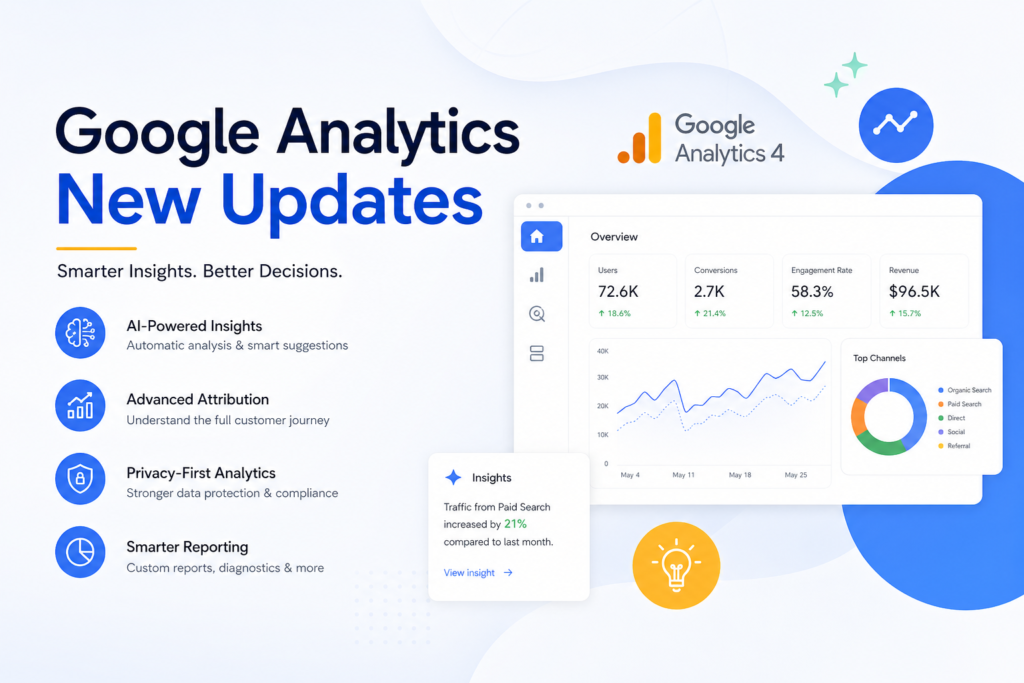
Digital marketing is evolving faster than ever, and analytics tools are evolving with it. Google Analytics 4 (GA4) is no longer just a reporting tool—it has transformed into a powerful, AI-driven decision-making platform.
If you’re a business owner, marketer, or student, understanding the latest updates in Google Analytics is essential to stay competitive in 2026.
🚀 The Shift: From Reporting to Predictive Intelligence
The biggest change in Google Analytics is its transition from “what happened” to “what will happen next.”
New AI-powered features now automatically analyze data and highlight insights like trends, anomalies, and performance shifts—helping users make faster decisions without deep manual analysis.
🔥 Key Google Analytics Updates in 2026
1. AI-Powered Generated Insights
Google Analytics now uses AI to explain your data in simple terms.
- Automatically detects traffic spikes or drops
- Suggests possible reasons behind changes
- Helps non-experts understand analytics easily
This reduces the need for manual data interpretation and speeds up decision-making.
2. Cross-Channel Budgeting & Forecasting
One of the biggest updates in 2026 is budget planning inside GA4.
- Predict future conversions based on ad spend
- Compare ROI across multiple platforms (Google, Meta, etc.)
- Test different budget scenarios
This means marketers can now plan campaigns directly inside Analytics instead of using spreadsheets.
3. Advanced Conversion Tracking & Attribution
Google Analytics now provides more accurate tracking of customer journeys.
- Better multi-channel attribution
- Ability to customize attribution per conversion
- Reduced data mismatch between platforms
This helps businesses understand which channel truly drives results.
4. Enhanced User Tracking Across Devices
GA4 improves how it identifies users across multiple devices.
- Tracks users across mobile, desktop, and apps
- Reduces duplicate data
- Builds a unified customer journey
This creates more accurate insights into user behavior.
5. New Attribution Analysis Reports
Google introduced a dedicated attribution analysis report in the advertising section.
- Shows the full customer journey
- Highlights the contribution of each channel
- Helps optimize marketing strategies
This gives a clearer picture beyond last-click attribution.
6. Privacy-Focused Analytics & Consent Tools
With increasing data privacy regulations, GA4 now includes:
- Consent tracking and diagnostics tools
- Privacy-first data collection
- Better compliance with global regulations
This ensures businesses can track data ethically and legally.
7. Smarter Diagnostics & Data Accuracy
Google Analytics now alerts you when something goes wrong.
- Detects broken tracking or missing events
- Improves data accuracy
- Helps fix issues quickly
This prevents poor data from affecting business decisions.
8. Improved Reporting & Customization
GA4 now offers more flexibility in reporting:
- Custom reports with “Explorations”
- Ability to copy reports across properties
- Built-in annotations for tracking events
This makes analytics more collaborative and easier to manage.
💡 Why These Updates Matter
These updates are not just technical improvements—they change how businesses use data.
With GA4, you can now:
- Predict future performance
- Optimize marketing budgets
- Understand customer journeys deeply
- Make faster, data-driven decisions
In simple words, Google Analytics is becoming a growth tool, not just a tracking tool.
📊 Final Thoughts
The latest Google Analytics updates clearly show one direction:
👉 Automation + AI + Privacy-first tracking
Businesses that adapt to these changes early will have a strong competitive advantage.
If you’re still using old analytics methods, now is the time to upgrade your strategy and fully embrace GA4.